Peg Spradlin is responsible for making many of the quilts you see in QM’s pages. Peg has sewn for us and our sister publications for many years. She’s a master.

Peg Spradlin
We asked Peg to share tips she found helpful as she created Quiltmaker’s Garden, the 30th anniversary commemorative quilt seen on the March/April ’12 cover.
Partial seams sound much worse than they are. I think people confuse them with set-in seams. You can sew partial seams, I promise. Follow Peg’s step-by-step below.
* * * * *
The Petunia and Sky blocks in Quiltmaker’s Garden feature partial seams, which can be tricky. If you make the partial seams too long or too short, sewing the final seam can be difficult.
I found that the first partial seam in these blocks should end 1/2″ away from the edge of block A as shown in photo 1 below.
Piece the next 2 units as regular length seams and press the seams away from block A (photo 2 below).
To attach the fourth and final unit, fold the first unit down as shown in photo 3 below.
Then position unit 4 and sew a full seam (photo 4 below).
The last seam can be the most difficult to position and sew because of the first partial seam, but following these steps and looking at the next pictures should help.
Align the edges of sections 1 and 4 and pin (photo 5 below).
Sew the last seam, joining it with the first partial seam taken in step 1 (photo 6 below).
The back of the block should look like this:
Remove the foundation papers before incorporating these blocks into the quilt.
* * * * *

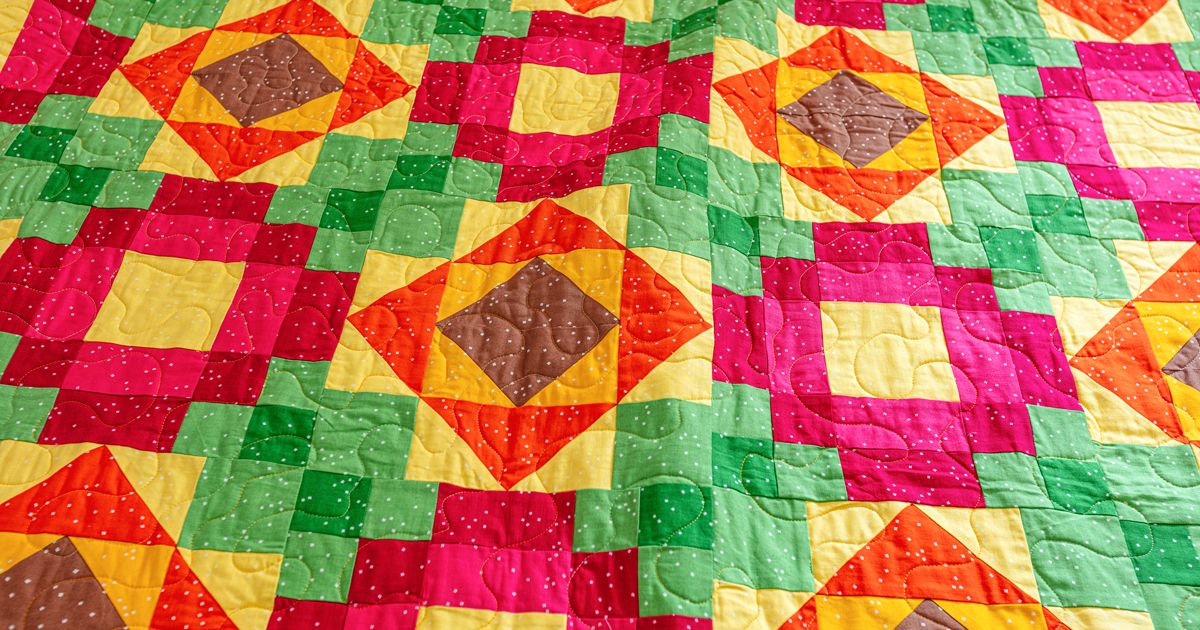
Quiltmaker's Garden, designed by Denise Starck and QM staff, made by Peg Spradlin. Part 1 of 5 appears in the March/April issue of Quiltmaker.


This is gorgeous!
Great tutorial on how to sew partial seams. Also, thanks for the photo of Peg. I’ve always wondered what she looks like. It’s nice to have a photo to connect with the name I’ve seen so often in Quiltmaker’s pages. The cover quilt this issue is ravishing this issue!
Peg spoke at our guild last fall and did a machine quilting workshop for us. Her work is outstanding and she is a very good teacher too!
The quiltmaker’s garden is something to see! The key concepts are visually displayed for all the geometric isometries. Wonderful work!
thank you for the “extra” tips i saw this pattern in the issue i recieved and wanted to make this quilt bbut after going over the instructions i was confused and became afraid to try the Partial seams , but now that i have read this maybe i will take that big step and try the pattern
this really wonderful
truly well written instructions. thank you. Now I’ll have to go home and try it!
I am newer to paper piecing and have only paper-pieced with scraps. How do I know what size (strips?) to cut the fabrics before I begin the paper-piecing?
I like to first cut a copy of the foundation block pattern apart into the individual numbered patches. Then I lay the numbered paper patch-number facing up-on the wrong side of the fabric and cut the fabric 1/2″ extra on all sides. Try to cut the edges that will be the sides of the block, on the straight of grain. If you enjoy taking classes, you might consider taking one on paper piecing because it can be a challenging technique to learn.