Hello! Happy Friday! Hope you had a great week, and have some fun quilty things to do this weekend!
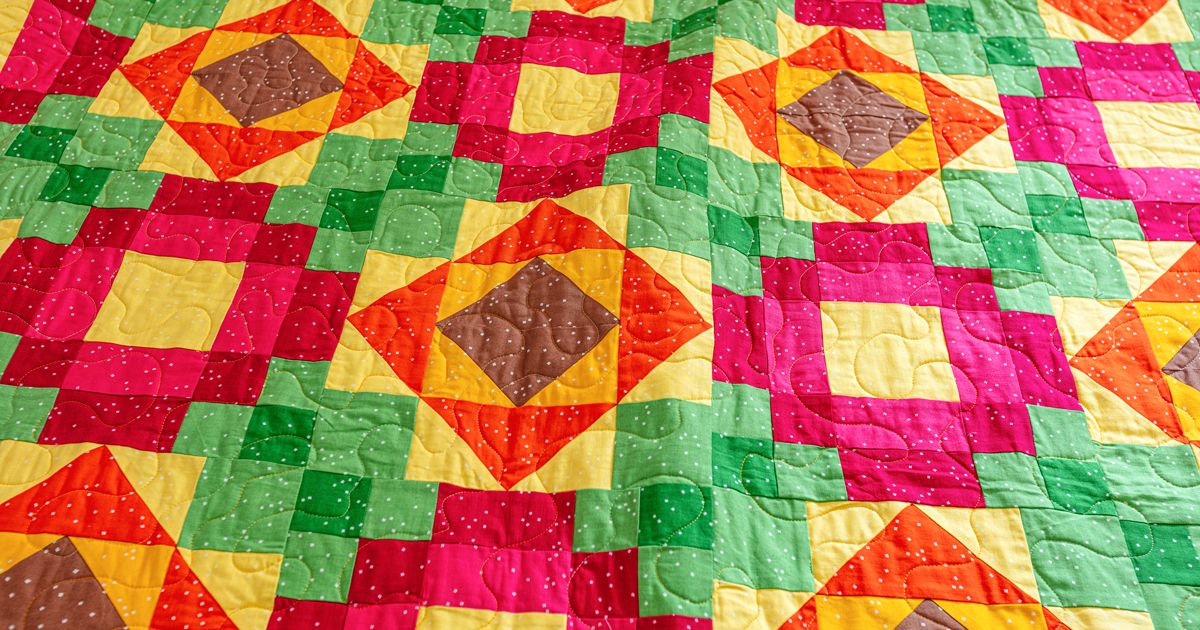
In the July/August ’11 issue of Quiltmaker we featured the pattern Salute to Plaid by Natalia Bonner (page 18). It’s a beautiful throw-size quilt and we love love loved it so we featured it in three different colorways.
We also included a chart for the alternate sizes—wall, queen and king sizes.
Often, when you want to make a different sized quilt than is shown in a pattern, you can do the math and figure out how many blocks you need to make a larger or smaller quilt. Since Salute to Plaid also has bands, we thought it might be a good idea to show you how to use the alternate size chart (page 22). (Just in case you aren’t sure what a “band” is, it’s strips of fabric that are sewn together, then crosscut into units.)
When making a quilt a different size, the trick is to figure out how many units and patches you need to make ONE block. Then multiply that by the number of blocks you are making.
Let’s take a look at the wall size version of Salute to Plaid (36″ x 36″). In the alternate size chart you can see that you will need 6 block X’s, 2 block Y’s and 1 block Z. If you keep going down the chart, you will see that you need 2 bands. You use the bands in block X.
Each block X uses 1 dark #1 A, 1 dark #2 A, and 1 med/light B. To make 6 block X’s you will need to multiply all of these patches by 6; so you will need 6 dark #1 A’s, 6 dark #2 A’s and 6 med/light B’s.
Now for the bands (that you will crosscut into units): In Step 2 of Salute to Plaid, you can see the strips of light, medium/light, medium #1 and medium #2 fabrics that you need to make 1 band. You will need to make 2 of these bands for this wall-size quilt.
From these bands you can cut the correct number of the unit 1’s–3’s. Each block X uses 2 unit 1’s, 1 unit 2, and 1 unit 3. Again, to make 6 block X’s you will need to multiply these units by 6; so you will need 12 unit 1’s, 6 unit 2’s and 6 unit 3’s.
If you want to make the queen or king size of Salute to Plaid, just do the same math. See the alternate size chart to see how many blocks you need, then multiply the patches of each block by that number. Make the appropriate number of bands that are listed in the chart and cut the appropriate number of units. Easy Peasy!
Now for the Y and Z blocks: Each block Y uses 4 each of units 4–6 and 4 D patches. To make 2 block Y’s, multiply all of the units and patches times 2, which will give you 8 each of units 4–6 and 8 D patches.
Block Z is easy since you only need 1 block Z. Just cut what you need to make 1 block!
Again, for the queen and king size quilts, just do the same math. See the alternate size chart to see how many blocks you need, then multiply the units and patches by that number to make your blocks.
Hopefully you can see that adapting a quilt pattern really isn’t that hard. You can do it! Just remember, whenever you want to adapt a quilt pattern to make the quilt larger or smaller, start with ONE block. Figure out how many patches or units you need for that ONE block, then multiply it by how many blocks you need to make. You’ll be making a different sized quilt in no time! And you might just have fun doing it.
Happy quilting!
Paula


Pingback: King Size Quilts: Three Buying Tips